Devin Samsa
Insatiable Box Set: Books 1-4Devin Samsa is a twin son of Wilder Samsa and Adrienne Ward, and one of the children through whom the Samsa family’s mixed human-werewolf future becomes visible. Wilder names him Devin, after his own maternal grandfather, while naming his twin Hunter after his father. The two boys are difficult for Wilder to distinguish, a detail that emphasizes their closeness as twins while also leaving Adrienne as the one person said to tell them apart. Devin’s significance lies less in independent political authority than in the way his body, affection, vulnerability, and upbringing test the family’s claims about what it means to be both human and werewolf.
Identity and Family Background
Devin is raised within the household formed by Wilder Samsa and Adrienne Ward, whose relationship is governed by the werewolf concept of a lifelong mate and by a wider arrangement involving the Samsa brothers. Wilder asserts that Adrienne is his mate and that he will marry her, while Lycell Samsa argues that his own children with Adrienne give him a competing claim. The resulting household is therefore not a conventional human family, but a shared werewolf family structure in which paternity, mating, inheritance, and pack welfare overlap. Devin enters that structure as one of Wilder’s sons and as the twin brother of Hunter Samsa.
His name carries deliberate genealogical meaning. Wilder explains that one son was named for his father and the other for his mother’s father, assigning Devin the latter inheritance. The naming links Devin to the older Samsa line even before the narrative gives him a developed voice or public role. He is not merely an unnamed pup in a large household: his identity is placed within a chain of family memory and succession.
Childhood and Return to the Household
When Adrienne recovers after spending a month in a coma, Wilder tells her that Devin and Hunter visited her every day. Their repeated presence at her bedside makes them part of the emotional cost of her absence and of the household’s effort to preserve a bond with their mother while she is incapacitated. Adrienne has also been separated from Lycell’s boys during that period, so the children collectively mark the family life interrupted by her illness.
Wilder and the other adults have to improvise care for the younger children. Two older werefemales are brought in because the three smaller children refuse formula milk; they are instead fed milk from a deer. This detail places Devin within a distinctly werewolf system of nurture, where human medical substitutes are inadequate and animal resources become part of domestic care. The children’s needs thus require the family to translate between human habits and werewolf biology rather than simply choosing one world over the other.
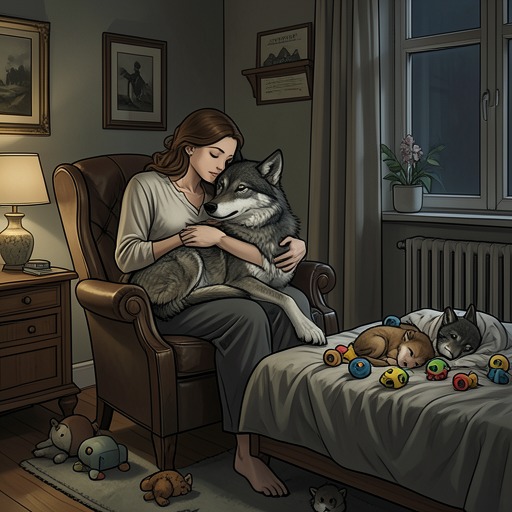
Devin’s reunion with Adrienne is the most openly affectionate of the twins’ homecoming. He runs to the door, welcomes his mother, and hugs her, producing in Adrienne a powerful feeling of love and contentment. Hunter initially remains at a distance before approaching with a small smile, whereas Devin immediately reaches for physical contact. Devin also holds Adrienne’s hand and does not want to let go. His behavior gives the recovery scene its clearest expression of attachment: after a month of separation, he responds not with ceremony or caution but with an urgent, childlike insistence on continued closeness.
The reunion also prompts Wilder to confront the children’s mixed inheritance. Adrienne observes that the boys are human too, while Wilder privately fears the implications of that humanity. Devin therefore functions as evidence in an unresolved family argument. He is loved as a son, yet his resemblance to human children raises questions about how the Samsa lineage will develop and whether human and werewolf traits can coexist without threatening the pack’s identity.
Injury and Medical Crisis
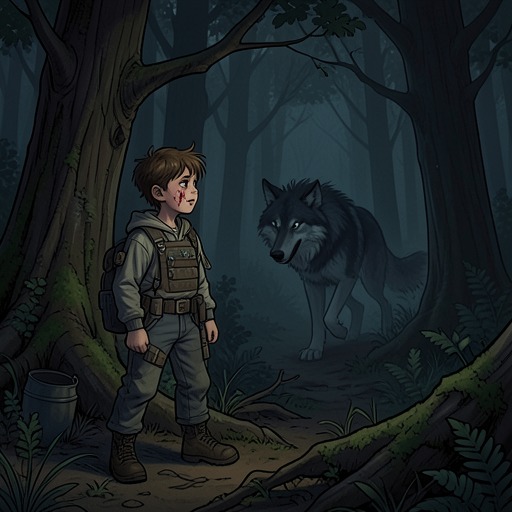
Devin’s most consequential action occurs when he ventures into the forest near the cave with Hunter. The twins are riding horses when a bear and her cub emerge from the woods and startle Devin’s horse. Devin falls backward, and before Hunter can reach him, both bears attack. The episode makes the wilderness an active force in the children’s lives rather than a distant backdrop: horses, bears, the cave, and the forest all belong to the environment through which young werewolves must learn to move.
Hunter drags Devin by the arms into the house, where Wilder discovers blood running down his torso. The family’s immediate response combines panic, parental protection, and practical medical intervention. Robert, a doctor, checks Devin’s pulse and determines that he has lost a great deal of blood. Because there is no time to take him to an ordinary hospital, Robert creates a tourniquet from available materials, cleans the wounds, and administers antibiotic and tetanus injections. When Devin’s clothing is cut away, two large puncture marks are visible on his arm and leg, confirming the severity of the attack.
Robert concludes that Devin still needs hospital-level treatment, but Wilder explains that the werewolves maintain their own hospital behind the ranch. Lycell has already summoned its nurses and doctors by text. This division between human and werewolf medical systems is central to Devin’s crisis. Robert’s professional knowledge saves time and stabilizes the boy, while the pack’s hidden medical infrastructure provides the setting in which further care can occur. Devin’s injury thus reveals a cooperative but guarded medical boundary: the family accepts human expertise, yet cannot openly expose the child or the ranch to human society.
Werewolf Law, Training, and Vulnerability
After the attack, Wilder rebukes the boys for traveling too far from home before he has taught them how to hunt and which animals to avoid. He warns that some animals are mortal enemies, and he includes humans among those enemies. The warning is both practical and ideological. Devin’s childhood is shaped by a world in which ordinary wilderness dangers coexist with the political danger of human discovery, and where survival depends on learning the distinctions between prey, predator, rival, and protected family member.
The attack also complicates the idea of rapid werewolf maturation. Devin belongs to a species whose young are expected eventually to leave home and find mates according to werewolf law, yet he remains vulnerable enough to be thrown from a horse and mauled by a bear. Wilder’s statement that Hunter and Devin will soon go out on their own and find mates presents adulthood as a legal and biological expectation, but Devin’s injuries show the distance between that future role and his current dependence on parents, doctors, and pack infrastructure.
His experience is consequently framed by competing normative systems. Adrienne does not fully understand the werewolves’ laws, including their hunting practices and inherited rules, while Wilder has been taught those laws since childhood and now enforces them as the head of a vast pack. Devin grows up inside that inherited order, but his emotional reunion with Adrienne and his vulnerability to animal violence keep the human dimensions of childhood in view. He is both a future werewolf adult subject to pack custom and a frightened child whose survival depends on care.
Narrative Role and Significance
Devin is important because the narrative makes the Samsa family’s future concrete through him. His name connects him to ancestral memory; his twinship with Hunter expresses continuity; his attachment to Adrienne gives the household an emotional center; and his injury exposes the costs of raising children in a concealed, predator-filled world. The family’s responses to him reveal its internal structure more clearly than abstract statements about pack law could do: Hunter acts as a rescuer, Wilder becomes a worried father and instructor, Robert applies medicine, Lycell mobilizes the werewolf hospital, and Adrienne’s recovery is measured partly by her ability to return to her sons.
Devin also embodies the tension between human and werewolf identity that Wilder fears but cannot resolve by command. The boy is embraced as a member of the Samsa family, fed through werewolf practices, protected by werewolf law, and treated by both a human doctor and hidden werewolf clinicians. His presence suggests that the future of the pack will not be secured by purity or separation. It will instead be negotiated through children whose lives cross the boundaries between human affection, werewolf kinship, animal ecology, and competing systems of law and medicine.